


 Free Newsletter

Trump’s $1.8B fund may be dead, but there are still paths to payouts
By Salvador Rizzo & Jeremy Roebuck, The Washington Post//June 3, 2026//
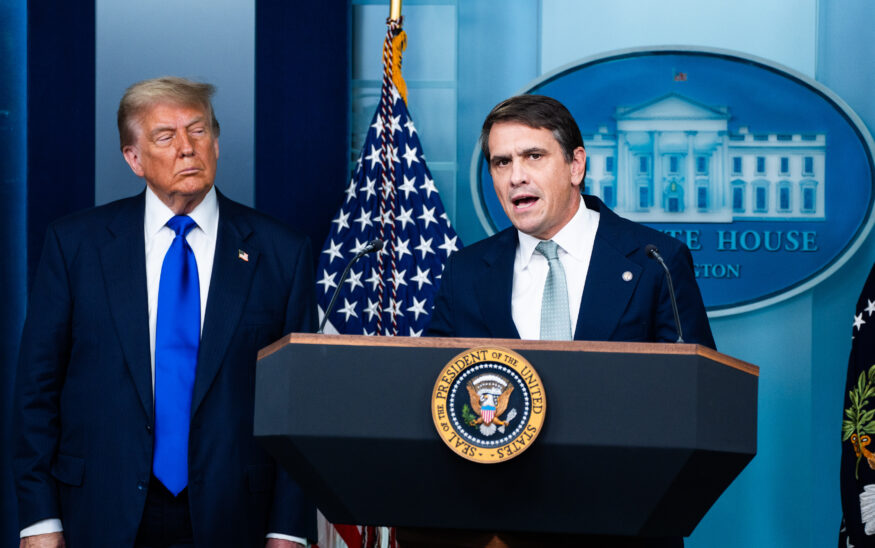
President Donald Trump, alongside then-deputy attorney general Todd Blanche, in the White House briefing room. (Demetrius Freeman/The Washington Post)
Trump’s $1.8B fund may be dead, but there are still paths to payouts
By Salvador Rizzo & Jeremy Roebuck, The Washington Post//June 3, 2026//


Summary
- Acting AG Todd Blanche told Congress the proposed $1.8 billion Anti-Weaponization Fund will not move forward.
- Existing Federal Tort Claims Act procedures still allow the Justice Department to settle claims from Trump allies and Jan. 6 defendants.
- The settlement agreement’s provision limiting future IRS tax claims against Trump and his family remains in place.
- Multiple federal lawsuits challenging the proposed fund remain active in courts in Virginia, Washington, D.C., and California.
Acting attorney general Todd Blanche sought to quell bipartisan backlash by assuring lawmakers Tuesday that the Trump administration‘s plan to create a nearly $1.8 billion fund to compensate those who claim they were targeted by politicized investigations was officially dead.
But his pledge left several questions unanswered and might not permanently close the door on Justice Department efforts to award payouts to supporters of President Donald Trump who say they were victims of a weaponized justice system.
“We are not moving forward with the fund, period,” Blanche told members of a House Appropriations subcommittee, referring to the idea that was laid out in an agreement the Justice Department struck last month with Trump’s personal lawyers to resolve several legal claims the president filed against the government in his personal capacity.
But Blanche declined requests from Democrats to put that in writing, which – along with a statement from another Justice Department official – stoked further confusion about the agency’s plans.
In a post to social media, Sen. Lindsey Graham (R-South Carolina) proposed that Congress create its own version of an “anti-weaponization” fund.
Stanley Woodward, the Justice Department’s No. 3 official and one of the signatories to Trump’s settlement deal, appeared to endorse the idea. He shared Graham’s post with the message “We’re on it” – only to delete that hours later. The Justice Department did not immediately respond to requests for comment to clarify Woodward’s remark.
Here’s a look at some of the key questions that remain:
Could Trump allies seeking compensation still get paid?
Even before the proposed $1.8 billion fund, mechanisms existed for the Justice Department to financially compensate people who claimed they were victims of politicized prosecutions under previous administrations.
And department officials already have signed off on deals awarding significant sums to Trump allies. Those include his 2016 campaign adviser Carter Page, his former national security adviser Michael Flynn and the family of Ashli Babbitt, the Trump supporter from California who was fatally shot by police during the Jan. 6, 2021, attack on the U.S. Capitol.
Under federal law, those seeking to file legal claims against the government must first submit a request under the Federal Tort Claims Act. That statute allows the Justice Department to investigate their request and decide whether to offer a settlement before any lawsuit is filed.
Hundreds of defendants charged or convicted as part of the investigation into the Jan. 6 riot had already filed such claims before the $1.8 billion fund was announced, though several attorneys leading those efforts have said the government has not yet responded to their requests.
Any deals reached through that process or through litigation filed in court are paid out from the government’s Judgment Fund, an uncapped pool of money Congress has appropriated to cover settlements involving federal agencies.
The fund proposed by Trump’s legal settlement would have drawn its $1.8 billion from that pot of money and granted a five-member commission, largely appointed by the attorney general, the authority to dole out awards to those with claims it deemed worthy.
But even with the plans for that fund now scrapped, the Justice Department could still strike deals on any claims it deems to be valid without congressional approval.
Will Blanche’s backtracking satisfy lawmakers?
The death of the proposed fund came after days of pushback from Senate Republicans who objected to the idea that a dedicated pot of taxpayer money could reward those involved in the Jan. 6 attack, including defendants who previously had been convicted of assaulting police officers that day.
Senate Majority Leader John Thune (R-South Dakota) said Wednesday that most members of the GOP caucus appeared to have been satisfied by Blanche’s backtracking Tuesday.
But the debate over settlements that could benefit Jan. 6 defendants may not be over.
In his social media post Tuesday, Graham suggested Congress establish its own fund to compensate those who claim they were unfairly targeted.
“There are many victims of the weaponized Biden Justice Department throughout this country. … I am proposing that we create a weaponization fund that will be available to those who can prove their claim against the federal government through the Federal Tort Claims Act,” Graham wrote on X on Tuesday evening.
It was not clear how his proposal would differ from the process that already exists, and a spokesperson for the senator did not respond to requests for comment.
Others, including several top Democrats, have floated the idea of legislation that would permanently restrict payouts to Jan. 6 participants. Some also have called for new laws limiting payout amounts that the Justice Department could independently authorize through the Judgment Fund.
Sen. John Cornyn (R-Texas) shared on social media a Wall Street Journal editorial Wednesday calling for legislation that would permanently bar the type of fund the Trump settlement had proposed.
What about the part of the settlement that offered Trump protection from IRS audits?
The deal to settle Trump’s legal claims also included another controversial element that “forever barred and precluded” the government from pursuing unpaid tax claims against Trump, members of his family or his businesses that arose before the settlement being reached.
That stipulation has drawn fierce criticism separate from the furor over the proposed fund, with critics deriding it as a deal that could spare the president and his family from millions of dollars in tax liability.
Blanche told lawmakers Tuesday that despite the plans to scuttle the $1.8 billion fund, the Justice Department still intended to stand by the protections extended to Trump under the tax part of the settlement agreement.
What happens to lawsuits challenging Trump’s settlement?
At least five federal lawsuits have been filed against the “Anti-Weaponization Fund” in D.C., Virginia and California.
One of those legal challenges, filed by a former Jan. 6 prosecutor who was fired last year as well as several critics of the Trump administration, last week led a federal judge in Virginia to order a temporary pause on any actions relating to the fund until at least June 12.
None of the groups suing over the fund have signaled they will drop their lawsuits.
Attorneys from Democracy Forward, the group that obtained the temporary court order blocking the fund, sent a letter to Justice Department officials after Blanche’s comments at the House hearing Tuesday, asking them to “clarify exactly what Acting Attorney General Blanche meant when he said the Department is not moving forward with the Anti-Weaponization Fund.”
“If you can say it on TV, you should say it in court,” Skye Perryman, the president of Democracy Forward, said in a statement.
In the Virginia case, U.S. District Judge Leonie M. Brinkema has set a hearing for June 12 to weigh whether the court should extend the temporary order blocking the fund.
A federal judge in D.C., Richard J. Leon, has scheduled a hearing for next Wednesday in a similar case filed by the group Citizens for Responsibility and Ethics in Washington, on whether to issue a temporary restraining order against the fund.
For the moment, those hearings are still on the court calendars.
Related Articles
Related Content


Latest Opinion Digests
- Criminal Law-Unlawful Reentry-Appeal Waiver-Substantive Reasonableness of Sentence
- Criminal Law-Supervised Release-Revocation-Substantive Reasonableness of Sentence
- Criminal Law-Supervised Release-Revocation-Substantive Reasonableness of Sentence
- Criminal Law-Supervised Release-Revocation-Substantive Reasonableness of Sentence
- Criminal Law-Sentencing Enhancement-Sexual Assault-Physical Force
- Criminal Law-Revocation of Supervised Release-Excessive Sentence-Substantive Reasonableness of Sentence
- Criminal Law-Murder-Tampering with Evidence-Motion to Suppress Evidence
- Criminal Law-Judicial Forfeiture-Drug Offenses-Default Judgment
- Criminal Law-Firearm Offense-Cross-Reference-Substantive Reasonableness of Sentence
- Criminal Law-Firearm Offense-Above-Guidelines Sentence-Upward Variance
- Criminal Law-Felon in Possession of Firearm-Anonymous Tip-Confrontation Clause






Top stories
- COA reverses dismissal of tow company’s breach of contract claim
- St. Louis attorney notches six-figure win in business case against investment giant
- Forum non conveniens dismissal reversed by Court of Appeals
- Jackson County jury awards millions in liability lawsuit
- Retro application of anti-stacking sentencing amendment rejected
- Death row inmate gets relief from ‘Batson’ waiver finding
- Jury sides with Columbia grocery store in slip-and-fall lawsuit
- Chief Disciplinary Counsel asks state’s top court to disbar attorney
