


 Free Newsletter

Advocacy group sues Missouri State University over bias policy, team
By Susan Szuch, USA TODAY Network via Reuters Connect//April 23, 2026//
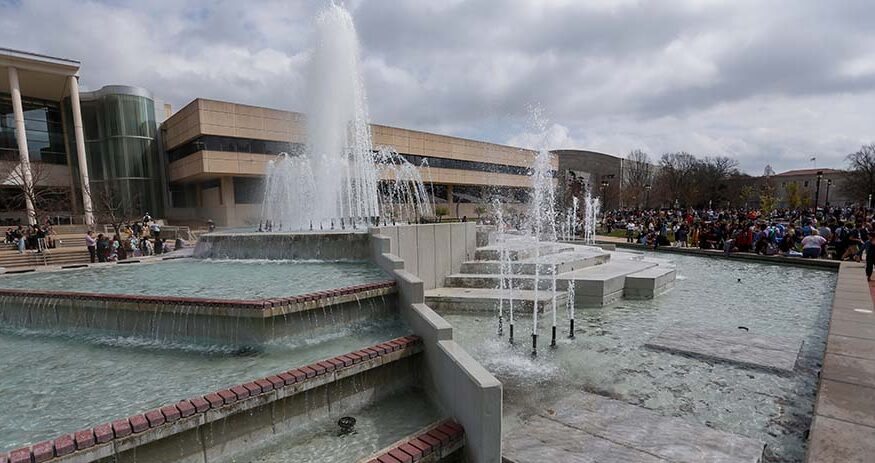
Students gather around the fountain at Missouri State University shortly after it was turned on for the first day in 2022. (USA TODAY Network via Reuters Connect)
Advocacy group sues Missouri State University over bias policy, team
By Susan Szuch, USA TODAY Network via Reuters Connect//April 23, 2026//


Summary
- Defending Education files suit in U.S. District Court Western District of Missouri
- Missouri State University bias response team established in 2016
- Plaintiff seeks permanent injunction against bias policy enforcement
- Speech First previously challenged bias teams at multiple universities
An advocacy organization is suing Missouri State University for violating students’ First and 14th Amendment rights.
Defending Education, a “national grassroots organization working to restore schools at all levels from activists imposing harmful agendas,” alleges in a filing with the U.S. District Court for the Western District of Missouri that the university’s Bias Response Team and bias policy are unconstitutional in that they violate students’ First and 14th Amendment rights.
“College campuses should serve as the ‘marketplace of ideas,’ where all perspectives are welcomed in the quest for knowledge, truth, and understanding,” DE wrote in an April 21 news release. “But at Missouri State University, officials have enacted a far-reaching policy designed to deter, discourage, and otherwise prevent students from expressing disfavored views about the political and social issues of the day.”
An MSU spokesperson said the university does not comment on pending litigation.
The MSU Bias Response Team was established in spring of 2016, according to reporting from KSMU, and was created to provide an organized and coordinated way for MSU to assess an incident or situation that might affect the university community.
“Any BRT response will be educational at its core. Voluntary interventions may include a variety of activities including discussion, mediation, training, counseling and consensus building,” according to the BRT website. “The BRT will not seek to discipline individuals for expression of views protected by the First Amendment of the Constitution of the United States.”
In the complaint filed on April 21, DE says that three unnamed MSU students are “suffering concrete injuries as a direct result of the University’s unconstitutional policies and actions.” The complaint says the students want to engage in speech that is covered by the bias policy but that they “credibly fear that the expression of their deeply held views will be considered ‘biased,’ ‘offensive,’ ‘discriminatory’ or the like.”
The advocacy group is seeking a declaratory judgement that the bias policy is unconstitutional; a permanent injunction barring MSU from enforcing the bias policy; a permanent injunction barring the BRT from “investigating, logging, threatening, referring, or punishing (formally or informally) students for bias incidents”; costs and expenses of this action and all other relief to which the plaintiff is entitled.
“Missouri State University’s vague, overbroad, and viewpoint-based definition of “bias” violates the First and Fourteenth Amendments to the U.S. Constitution,” DE said in the April 21 news release. “We look forward to the day when not only are our own members’ rights vindicated in federal court, but when all college students, of every perspective and belief, can express themselves without fear of being censored or punished.”
What is a bias response team?
A bias response team is a group of professionals that responds to incidents of bias or discrimination from microaggressions to overt acts of prejudice, according to The Oxford Review, a site that provides research briefings on leadership, management, organizational and human development. Teams offer support and advocacy to those affected by bias incidents, as well as investigate and document incidents to track patterns, identify trends and develop prevention strategies.
Bias response teams generally do not have the power to discipline or sanction campus community members and do not shut down free speech, wrote Ryan A. Miller in a 2019 article for Inside Higher Ed. Miller is a professor of higher education at the University of Tennessee, Knoxville. BRTs generally refer incidents that involve institutional policy violations or criminal acts to the appropriate groups on campus, such as student conduct offices or campus police.
In 2022, Speech First identified 456 bias reporting systems in public and private universities across the United States. Speech First is a First Amendment advocacy group that has filed lawsuits against universities across the country.
Speech First has filed and then settled, or won and settled, lawsuits regarding BRTs against the Universities of Texas, Michigan, Central Florida and Illinois as well as Oklahoma State University. Those universities had to disband their BRTs and rewrite harassment policies as a result, reported Inside Higher Ed.
Related Articles
Related Content


Latest Opinion Digests
- Torts-Defamation-Scope of Review of Dismissal Motion
- Probate-Asset Inventories-Burden of Proof
- Elections-Initiative Petition-Sufficiency of Summary Statement
- Domestic Relations-Protective Custody-Cessation of Reunification Efforts
- Domestic Relations-Order of Protection-Sufficiency of Evidence
- Domestic Relations-Dissolution-Calculation of Equalization Payment
- Criminal Law-Post-Conviction Relief-Ineffective Assistance of Counsel
- Criminal Law-Post-Conviction Relief-Ineffective Assistance of Counsel
- Torts-Truck Accident-Liability Determination
- Domestic Relations-Child Support-Contempt
- Criminal Law-Post-Conviction Relief-Ineffective Assistance of Counsel



Top stories
- COA affirms denial of petition to implement children’s services sales tax
- Missouri Supreme Court considers suspension for attorney over trust account violations
- Distracted driver case settles for $650K after crash causes permanent injuries
- Missouri Supreme Court weighs discipline for attorney who used racial slur toward assistant prosecutor
- Missouri Lawyers Media celebrates Women’s Justice Award winners
- Eastern District appellate court celebrates milestone anniversary
- COA affirms $58M verdict for worker injured by exposure to food flavoring
- Missouri bar exam pass rate declines slightly in latest results
